пʼятниця, 11 грудня 2020 р.

Дистанційне навчання 10-A (12.12.2020)

Дистанційне навчання 10-A (12.12.2020)

Lesson

Saturday, the twelfth of  December

Theme: Appreciation Letter


 Appreciation Letter

It's always a good idea to write a letter of appreciation to express thanks and gratitude to someone who has provided help or assistance to you, whether this was during the course of a job search or simply in the daily course of your performance in the workplace.

It’s also a good idea to write personal letters or email messages showing your appreciation and thanks for those who have helped you in your personal life.

These letters aren’t difficult to write, and reviewing a sample letter of appreciation may make it even easier for you.

Sending a letter of appreciation is a great way to reach out and make others aware of your gratitude for their help. It's a courteous gesture – and also helps increase the likelihood that people will lend you a hand again in the future. 

What to Include in Your Letter

A letter of appreciation does not have to be long. Sincerity is more meaningful than length. Begin the letter with a greeting, and then let the recipient know why you're writing.

For example, you might say: "Thank you for bringing me up to speed on the new accounting program," or "I just wanted to let you know how much I've appreciated your advice over the past two weeks as I deliberated over those two job offers." 

Not sure what to write? Here are thank you quotes for a variety of circumstances that you can tailor for your own correspondence, and include in your letter or email.

Next, share more details about how much the recipient's help has meant to you. Thank them again before your closing sign-off. 

Your letter of appreciation can be as simple as a short thank-you email, but since email inboxes overflow, it might be even more meaningful to mail a handwritten letter or card.


Sample Appreciation Letter

This is an appreciation letter example

Avery Jones

123 Main Street, Anytown, CA 12345 · 555-555-5555 · avery.jones@email.com


September 1, 2018


Viola Lee

Vice President, Customer Relations

ACME Financial

123 Business Rd.

Business City, NY 54321


Dear Ms. Lee,


Thank you for taking the time to talk with me today. I sincerely appreciate the time you spent reviewing my career goals and recommending strategies for achieving them. Your advice was very helpful and gave me a new perspective on available opportunities.

I especially appreciate your offer to connect me to others in your network. I plan on following up with the contacts you emailed me right away. I will also use the online networking resources you recommended to further my job search.

Any additional suggestions you may have would be welcome. I'll update you as my search progresses.

Again, thank you so much for your help. I greatly appreciate the assistance you have provided me.

Best regards,

Avery Jones (signature hard copy letter)

Avery Jones


Work in pairs

Divide the sentences into two colons: dos and don’ts.

1. Use simple grammar. Avoid things like the passive

2. Use smileys.

3. Start a new paragraph for each topic.

4. Use informal greetings and endings.

5. Use respectful and polite tone.

6.  Use formal linking words

7. Use words/ phrases in the passive

8. Use numbers and bullet points to make the message clearer.

9. Use less formal language

10. Use abbreviations like coz and uni


Homework.

Imagine you spent three weeks at your English penpal's house. Write a letter to the family thanking them for their hospitality.


https://www.thebalancecareers.com/types-of-thank-you-letters-2063990


четвер, 10 грудня 2020 р.

Дистанційне навчання 4-В (11.12.2020)

 Дистанційне навчання 4-В (11.12.2020)

Lesson

Friday, the eleventh of  December

Theme: Виконання письмової роботи


Viktoriia Novikova приглашает вас на запланированную конференцию: Zoom.

Тема: Англійська мова 4-В

Время: 11 дек. 2020 09:00 AM Киев

Подключиться к конференции Zoom

https://us04web.zoom.us/j/73407904162?pwd=OUszL2RqRDEzbFk1SG4xZXdvWlZLZz09

Идентификатор конференции: 734 0790 4162

Код доступа: NBtx0G


1. Do exercise 3 page 44 SB

To present new vocabulary - Parts of the body

2. Do exercise 1 page 25 WB

3. Do exercise 4 page 45 SB

To present new vocabulary - Appearance

4. Do exercise 2 page 25 WB

Hometask:

1. Learn by heart new vocabulary

2. Fill in the crossword and find the hidden words.

3. What body parts are they? Put the letters in the correct order.


SEND PICTURES\PHOTOS OF THE PAGES TO MY EMAIL 

VNOVIKOVA835@GMAIL.COM

YOU ARE FREE TO ASK QUESTIONS


https://viktoriianovikova99.blogspot.com


середа, 9 грудня 2020 р.

Дистанційне навчання 10-A (05.12.2020)

 Дистанційне навчання 10-A (05.12.2020)

Lesson

Saturday, the fifth of  December

Theme: Booking tickets and hotel rooms by phone


Making the booking

I’d like to book a (single / double / twin) room for two nights, please.I’d like to make a reservation for a (single / double / twin) room for the night of (date), please.(a reservation = a booking)

Do you have any double rooms left for the weekend?Do you have any double rooms available this weekend?(left = available)

How much is… a single room / a double room / a suite?

What time is check-in? (check-in = when you arrive and give your passport information)What time is check-out? (when you leave and pay)What time is breakfast?

Are all your rooms ensuite? (= with bathroom)Is there wifi in the room?Is there a lift? (life / elevator)

Booking a Hotel Room in English

Types of room

double room = room with a double bed (for two people) twin room = room with two beds

single room = room with one bed (for one person)

suite = more than one room (e.g. bedroom and living room

cot = a bed for a baby

Availability

fully-booked = no rooms available

Other facilities

ensuite bathroom = a bathroom attached to the bedroom

a safe = a box with a key where you put valuables (passport, jewellery, money etc)

a minibar = a small fridge with drinks inside such as coke, water, juice, wine

tea and coffee making facilities = a kettle (to boil water), cups, coffee, milk, sugar and tea sachets

(24-hour) room service = meals delivered to your room

laundry / dry cleaning service = your clothes can be washed for you

bar and restaurant = the hotel has a bar and a restaurant for drinks and meals

wifi = internet connection (pronounced wai – fai)

full English breakfast = big breakfast with toast, eggs, bacon, cereal, etc

continental breakfast = small breakfast with croissant, coffee, juice

a wake-up call = when the telephone rings to wake you up


AT THE HOTEL 
Task 1. Learn the following words and phrases:


Task 5. Read the text about hotels. Choose from (A–H) the one which best fits each space (1–6). Use all choices. 
A. which are the best and most expensive. 
B. types of hotel accommodation. 
C. usually employ about one staff member.
D. fail to show up without cancelling your reservation. 
E. the housekeeping staff. 
F. overnight lodging for business people. 
G. includes breakfast, lunch and dinner. 
H. in good working order.

AT THE HOTEL 
Whenever people travel on business they need to stay at hotel. Hotels provide (1) … . Its basic service is providing a room to sleep in. But most hotels also have at least one restaurant or a caf. Many hotels also offer room and services for meetings, and some have shops and even offer entertainment. 
Big and respectable hotels (2) … for every two rooms. The hotel staff works around the clock to make the guests comfortable. (3) … cleans each room daily. Bellhops carry luggage and packages to the guests’ rooms. The engineering department keeps the hotel’s electricity, plumbing, heat and air conditioning (4) … . Some hotel restaurants provide room service, by which guests can have food and beverages brought to their rooms. 
However pleasant and polite receptionists may seem, most hotels have very strict policies. When you book a room you usually have to make a deposit. But if you cancel your reservation you lose it and if you (5) … the hotel charges one night’s room rate on your card. Also you have to check out by 12 pm, otherwise you’ll be charged extra money. 
Hotels are usually graded with stars from one-star to five-star, (6) … . You can also stay in a Bed & Breakfast (B&B) (also called Guest Houses) where you pay for a bedroom, possibly an ensuite (a room with private bathroom) and breakfast. (7) … are as follows: 
• a single room: for one person with a single bed; 
• a double room: for two people with one double bed; 
• a twin room: for two people with two single beds; 
• half board: includes breakfast and dinner; 
• full board: (8) … ; 
• B&B: just the room and breakfast.


Task 4. Read this conversation in a hotel and put the lines in the correct order:
- Certainly. A single room or double? 
- Just this one bag 
- Yes, sure. Do you want my address too? 
- Here is your key. Your room number is 311. I hope you enjoy your stay. 
- Single, please. 
- Good evening. Can I help you? 
- A shower. How much is the room? 
- Yes, please. Can I have a room for the night? 53 
- No, thanks. Just breakfast. Can I pay by credit card? 
- No. Just a signature. Do you have any luggage? 
- Yes, of course. We take Visa and Access. Could you sign the register, please? 
- Would you like a room with a shower or a bath? 
- 72 pounds for the room and breakfast. Would you like an evening meal? 
- Thanks.


Task 6. Translate the words and phrases into Ukrainian: 
Arrive, guest, chambermaid, expensive / cheap, fill in a registration form, reserve, express service / urgent service, depart / check out, the reception desk / counter, confirmation, accommodation, single / double room, book in advance, porter (U. K), doorman, suite, hotel clerks / attendants, tip (extra pay), receptionist.


Homework
Imagine
In a month two representatives of your company will arrive in Vermont, the USA and plan to be there for a week. Using examples given below try to write your own letter of inquiry to the best hotel in the city:


Дистанційне навчання 10-A (21, 28.11.2020)

Дистанційне навчання 10-A (21, 28.11.2020)

Lesson

Saturday, the twenty-first of November

Theme: Business trip abroad. Information about the arrival/departure of the plane, train, bus. Transport delays. Luggage compartments. 


How to get ready for a trip?

1. Pack appropriately

Organize your luggage and put everything in its designated place. Bring important documents like your passport, ID, and other booking details. Have a soft copy of those files on your phone in case of emergencies. Make sure that gadgets like your mobile phone and laptop are fully charged. Bring clothing and shoes that are versatile. 

2. Map out your day

Before leaving the country, plan ahead. Create maps for all your appointments. Download an offline map app on your phone to get a general idea of directions when you have no internet access.

3. Represent your company well

Remember that when you meet prospects or clients, whether inside and outside your home country, you are representing your company. How you dress and what you say give the people you meet a first-hand impression of what your company is like.

4. Talk to your bank and keep your receipts

Inform your bank in advance about your destination and the dates you will be there to make sure that your credit and debit cards are working. Keep your receipts for company records or reimbursements when you get back.

5. Eat and sleep right

Pack in advance and get as much sleep as you can before the trip. Eating properly and getting at least a minimum amount of sleep make you function better throughout the entire day and for the duration of the trip.


GOING ON A BUSINESS TRIP

John Thompson is an international sales representative for a large multinational corporation with its headquarters in Liverpool. He often has to travel overseas to visit factories and meet with foreign clients. Next week, he will be visiting an Auto Show in Beijing for three days before going on to Shangai to see his clients. 

    His secretary, Tracy Fisher, usually handles his travel arrangements. She calls the travel agency to make the reservation. She has to consider factors such as the check-in time, departure and arrival times, and visa requirements (if any). 

    Once Mr. Thompson has his tickets and travel documents in order, Tracy calls the travel agency again to confirm his reservation. Tracy is also responsible for making his hotel reservations. Since Mr. Thompson often has to meet guests at his hotel, he wants her to make sure that a large suite will be ready for him when he arrives at his destination. 

    When he goes abroad for business, his company pays for his flights. Thompson usually travels in business class. When he has enough frequent flyer miles, he can upgrade to first class. He is such an experienced traveler that when there is turbulence, he usually sleeps right through it. His only complaint is that he often suffers from jet lag, especially on long trips. 

He usually arrives at the airport two hours before his flight is scheduled to depart. There, he checks in and receives his boarding pass. He is also informed of his gate and seat number. If he has enough time, he may visit the duty-free shops in the airport. This time he arrived early at the airport and so he is doing some shopping for his relatives. 

    When he arrives at his destination, he makes sure his passport, visa, and arrival card are in order so he can quickly go through customs and immigration. He has the following advice for business travelers: 

“Always pack lightly. I usually take one check-in and one carry-on baggage. As a business traveler, you will constantly be on the move, so bring the essentials and leave the rest at home.” 

“Don’t carry a lot of cash. You should take most of your money in cards. They can be used almost anywhere.” 

“Try to get plenty of rest before and after your flight. If you are travelling from New York to Beijing, you don’t want to suffer from jet lag.” 

“Last but not least, remember the old saying —‘When in Rome, do as the Romans do.’ Try to learn as much as possible about the country you are travelling to and follow the local customs.”


Task 3. Decide if the following statements are true (T), false (F) or not in the text (N). 

1. The company has factories in Liverpool. 

2. Tracy helps Mr Thompson organize his trips abroad. 

3. Mr Thompson travels both by sea and by plane. 

4. Mr Thompson travels only by business class. 

5. Mr Thompson wears a suit on his business trips abroad. 6. Mr Thompson arrives a few hours before his flight. 

7. Usually he doesn’t have large luggage. 

8. When he travels, Mr Thompson has problems with sleep. 

9. Before travelling abroad Mr Thompson reads information about foreign countries.


Business etiquette abroad 

— It’s possible to arrive at the business meeting a few minutes later after the scheduled time. 

— It’s a good idea to exchange business cards at the beginning. 

— A male can shake hands with a female business partner. 

— Discuss business only before meal. 

— Avoid physical contact while discussing business (e.g. pat him/her on the shoulder). 

— Giving presents at business meetings is forbidden. 

— Avoid alcohol and smoking. 

— Don’t say ‘no’ even if you disagree with your partner. 

— Always say ‘thank you’ for a lunch/dinner organized by your business partners.
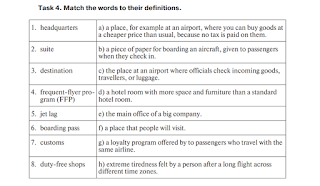


Task 3. Complete the sentences with the words from the box. suites ° jet lag ° arrangements ° destination ° scheduled ° FFP ° headquarters ° overseas ° reward ° host
1. Mr Grant is a busy person, so his assistant takes care of his travel …. 
2. At the customs the passengers are often asked about their … and how long they are going to stay. 
3. Whenever I travel from London to New York I suffer from … . 
4. Nowadays many airlines have introduced … that aim to create a sense of loyalty among their clients and … them with free airfare, upgrades and many more.
5. Our hotel … are designed for business travelers who appreciate additional space and may use it to … small meetings or entertain clients. 
6. The conference was originally … for October 12, but it had to be canceled. 
7. Every morning all offices of our corporation get new instructions from … in London. 
8. After I graduated from university I went … and worked as a journalist in Canada and the USA.

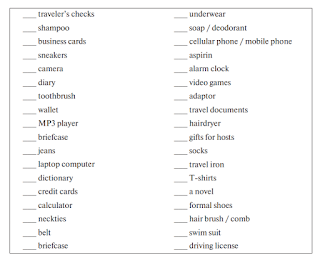
Task 4. Pack your suitcase. 
Task 5. Read the text about hotels. Choose from (A–H) the one which best fits each space (1–6). Use all choices. 
A. which are the best and most expensive. 
B. types of hotel accommodation. 
C. usually employ about one staff member.
D. fail to show up without cancelling your reservation. 
E. the housekeeping staff. 
F. overnight lodging for business people. 
G. includes breakfast, lunch and dinner. 
H. in good working order.

AT THE HOTEL 
Whenever people travel on business they need to stay at hotel. Hotels provide (1) … . Its basic service is providing a room to sleep in. But most hotels also have at least one restaurant or a caf. Many hotels also offer room and services for meetings, and some have shops and even offer entertainment. 
Big and respectable hotels (2) … for every two rooms. The hotel staff works around the clock to make the guests comfortable. (3) … cleans each room daily. Bellhops carry luggage and packages to the guests’ rooms. The engineering department keeps the hotel’s electricity, plumbing, heat and air conditioning (4) … . Some hotel restaurants provide room service, by which guests can have food and beverages brought to their rooms. 
However pleasant and polite receptionists may seem, most hotels have very strict policies. When you book a room you usually have to make a deposit. But if you cancel your reservation you lose it and if you (5) … the hotel charges one night’s room rate on your card. Also you have to check out by 12 pm, otherwise you’ll be charged extra money. 
Hotels are usually graded with stars from one-star to five-star, (6) … . You can also stay in a Bed & Breakfast (B&B) (also called Guest Houses) where you pay for a bedroom, possibly an ensuite (a room with private bathroom) and breakfast. (7) … are as follows: 
• a single room: for one person with a single bed; 
• a double room: for two people with one double bed; 
• a twin room: for two people with two single beds; 
• half board: includes breakfast and dinner; 
• full board: (8) … ; 
• B&B: just the room and breakfast.

Task 6. Read the text and find out how culture influences business etiquette.
CULTURE MATTERS … 
Every culture is different, and has different styles of etiquette. Every day deals are lost because cultural misunderstandings. These misunderstandings do not have to be huge to have a negative effect on your business – a poor first impression could leave your prospective partner with a bad feeling. Knowing the right etiquette can help you avoid this and save you a great deal of time and money. Mr Thompson shares what he has learned from his experience: 
Greeting. Handshakes are the typical form of physical greeting in most countries. But they are longer in the Middle East than in Western countries. It is recommended that you wait for the other person to withdraw his/her hand before you do. If you are a man greeting an Arab businesswoman, wait for her to initiate a hand shake as some conservative women may choose to not shake hands with men. 
Time and Space. Being punctual is one of the easiest ways to make a good impression without a lot of effort. In some cultures, it is not expected that people will be on time. For example in Latin America it is acceptable to be a little late. But if your colleague or customer is late for a meeting, it is best to take a relaxed view. People from different cultures also have different ideas about personal space. Standing close or touching another person during the conversation is considered appropriate. In Mexico, it is OK to give a friendly pat on the back, but in China you should never touch the other person. 
Business cards. Nowadays people rarely use business cards in the U.S and in Europe because you can do more things with a smartphone. But in many countries you won’t be taken seriously if you don’t have a business card to give someone when you greet. The business card exchange is extremely important in Japan – almost ceremonial. Always give business cards with two hands and remember to admire and examine the card when you receive it. The more time you spend looking at it indicates the more respect you have for the person. 
Meals. Very often international business is negotiated and discussed at social events, like business lunches and dinners. Never eat with your hands, even if it is a sandwich or a pizza. Use a napkin or other utensils. In the US business may be conducted over breakfast, lunch or dinner. In Germany business matters are usually discussed before or after the meal; never during. The Chinese do not discuss business at any meal. In Japan you should never service yourself to pour a drink. Your host, or someone else at the table, will fill your glass for you. In Australia, alcohol is discouraged at business lunches. Drinking moderately at business meals is acceptable in Germany; in Russia, you are expected to drink to establish closer relationships. In most European countries and in the US it is considered polite to thank your host for a meal. But never do this in India – it is considered a form of payment and, therefore, insulting. 
Gifts. Depending on where you’re going, gifts in business may be expected in some countries, and could be considered a bribe in others. Always wrap your gifts for Japanese partners. The value of a gift is less important than thoughtfulsness with which it was prepared. In China you have to give and receive gifts with both hands. Besides, it’s considered rude to open a gift in front of the person who gave it. On the contrary in Africa, gifts are opened immediately upon receipt. Many US companies discourage or limit gift giving as it may be seen as a bribe. Mostly it is polite to give small gifts when meeting someone, but avoid giving very expensive gifts. Otherwise this can make your partner might feel uncomfortable. 
Agreeing and disagreeing. When offering a deal to your business partner you are expecting a ‘yes’ response. But be ready for the unexpected. For example, the Japanese typically respond with ‘yes’ as you talk to them even if they disagree with you. They say it just to acknowledge that they understand what you are saying. It is similar to Indian culture where saying ‘no’ is impolite. So instead of saying ‘no’, respond with ‘possibly’, ‘I’ll try’, ‘we’ll see’. And remember that Bulgarians nod if they disagree with you and shake their heads to say ‘yes’.

Task 7. Decide if the following statements are true (T), false (F) to check how you have understood the text. Comment on your opinion.
1. In Brazil it is acceptable to be a bit late for the meeting. 
2. Women don’t do business in Saudi Arabia. 
3. Business cards are losing popularity all over the world. 
4. Give business cards with both hands in China. 
5. In Germany business matters are usually discussed during the meal. 6. It’s not appropriate to eat pizza or sandwich with your hands. 
7. In Japan you can help yourself if you want a drink. 
8. In the US gifts may be regarded as a bribe. 
9. In China your business partners open gifts as they receive them. 
10. If Japanese says ‘I’ll try’ or ‘possibly’ it is likely to mean ‘no’.

Your home task for the next lesson is
Work in pairs, write a dialogue. Imagine that you are going on a business trip. Describe how you are going on a trip, what necessary things you will take with you. Also, you can write a dialogue, which may take place at the airport, with a business partner etc. 
Dream up!


неділя, 29 листопада 2020 р.

Дистанційне навчання 10-A (30.11.2020)

Дистанційне навчання 10-A (30.11.2020)

Lesson

Monday, the thirtieth of October

Theme: George Byron. Life And Career


- What are your favourite kinds of books? Use the keywords to help you: poems, plays, sonnet, tales, novels, stories, detective stories, adventure stories.


Watch the presentation about life and career of George Byron and do some tasks

https://drive.google.com/drive/folders/1Lq1Ka7BVghNWjYoRSsTZlTRuJcrtSpD6?usp=sharing


The Romantic Period began roughly around 1798 and lasted until 1837. The political and economic atmosphere at the time heavily influenced this period, with many writers finding inspiration from the French Revolution. There was a lot of social change during this period. Calls for the abolition of slavery became louder during this time, with more writing openly about their objections.

After the Agricultural Revolution people moved away from the countryside and farmland and into the cities, where the Industrial Revolution provided jobs and technological innovations, something that would spread to the United States in the 19th century. Romanticism was a reaction against this spread of industrialism, as well as a criticism of the aristocratic social and political norms and a call for more attention to nature. Although writers of this time did not think of themselves as Romantics, Victorian writers later classified them in this way because of their ability to capture the emotion and tenderness of man.

Lord Byron differed from the writing styles of Keats and Shelley. He was heavily influenced by the satire and wit from the previous period and infused this in his poetry. His satire Don Juan (1819-1824) is told in 17 cantos, divisions of long poems, and is based on the traditional legend of Don Juan. Byron changes the original telling of the story and instead of creating a womanizing character, he makes Don Juan someone easily seduced by women.

The cantos follow his character’s journey as he travels throughout Europe meeting several women and continually trying to escape from trouble. Byron’s other notable work is Childe Harold’s Pilgrimage (1812-1816), another lengthy narrative poem. This poem was largely biographical and discusses many of Byron’s personal travels. It describes the reflections of a young man who is seeking new beginnings in foreign countries after experiencing many years of war. This poem is significant because it introduced the Byronic hero, typically a handsome and intelligent man with a tendency to be moody, cynical, and rebellious against social norms.


GEORGE GORDON BYRON

As we know George Gordon Byron (1788—1824) was the most colourful of the English romantic poets. There is no doubt that his adventurous life was as interesting as his poetry; his poetry reflects his own experiences and beliefs. Sometimes it is violent, sometimes it is tender, and frequently it is exotic.

George Gordon Byron was born in London, but he lived first 10 years in Scotland with his mother. His father, who had abandoned Byron's mother, died when the boy was 3. Byron inherited the title Lord Byron at the age of 10, upon the death of one of his relatives. Then he returned to England, where he attended Harrow School and Cambridge University. Byron's first book of poems, «Hours of Idleness» (1807), was severely criticized by the «Edinburgh Review», a Scottish literary magazine. Byron replied with «English Bards and Scotch Reviewers» (1809), a verse satire in which he attacked almost every notable literary figure of the day.

From 1809 to 1811 Byron travelled through southern Europe and parts of the Near East. In 1812, he published the first two sections of «Childe Harold's Pilgrimage». Such verse tales as «The Bride of Abydos» (1813) and «The Corsair» (1814) kept him in the public eye. In 1815 Byron married Anne Isabella Mibanke, they had a daughter, Ada, but their marriage wasn't happy and a long one. Rumours that Byron had committed incest with his half-sister, Augusta Leigh, broke Byron's marriage and he had to leave England forever.

Byron went to Switzerland, where he met his fellow poet Percy Bysshe Shelley. Then he moved to Italy, where he carried on a long romance with the Countess Teresa Guiccioli and was involved in Italian revolutionary politics. There he wrote such dramas as «Manfred» (1817), and «Cain» (1821). His last and greatest work was epic «Don Juan», it was long, though unfinished. In 1823 Byron joins the Greeks in their war for independence from the Turks. After a brief illness, he died in Missolonghi, Greece.

First two sections of Byron's «Childe Harold's Pilgrimage» were written as a fictional allegory with the stanza form and many features of the literary style of the Elizabethan poet Edmund Spenser. This work and «Turkish Tales» (1813—1816) that followed defined the character type known as «the Byronic hero». This character is the melancholy, defiant, proudly self-assured man associated with Byron and widely imitated in later literature.

During his last years, Byron wrote historical and Biblical tragedies, such as «Sardanapalus» (1821) and «Cain». «Don Juan» is considered the masterpiece of his Italian period. In this poem Byron deflates the legendary lover Don Juan to the level of a comic epic hero.


QUESTIONS

1.    When was Byron born?

2.    Where did he spend his childhood?

3.    Where did he study after school?

4.    When did he travel through Europe and Near East?

5.    What is «Childe Harold's Pilgrimage» about?

6.    What other Byron's works do you know?


VOCABULARY

adventurous — захоплюючий

to abandon — залишати

to inherit — успадковувати

rumour — чутка

incest — кровозмішення

defiant — непокірний

proudly — гордовито                        

to deflate — применшувати

self-assured — самовпевнений


Homework

Your task is to choose the most amazing verse (in your opinion) and analyze it, tell what the author tried to convey to the reader, what problem he wanted to reveal, etc.


вівторок, 24 листопада 2020 р.

Дистанційне навчання 4-В (25.11.2020)

 Дистанційне навчання 4-В (25.11.2020)

Lesson

Wednesday, the twenty-fifth of November

Theme: British countries


1.  Let’s remember the usage of the indefinite article a/an and the definite article the

https://learnenglishkids.britishcouncil.org/ru/grammar-practice/articles

Let's remember There is -There are

https://learnenglishkids.britishcouncil.org/ru/grammar-practice/these-those

Let's remember some/any

https://learnenglishkids.britishcouncil.org/ru/grammar-practice/have-got


2. Do Exercise 8 p. 33 SB

Do Exercise 1-3 p. 35 SB

Do Exercise 4 5 p.15 WB


3. Work with vocabulary

Let's repeat the vocabulary from the last lesson!

Places in a town

airport - аеропорт

art gallery-художня галерея

park-парк

fire station-пожежна станція

post office-поштове відділення

gym-спортивна зала

bank-банк

library-бібліотека

aquarium-акваріум

museum-музей

hospital-лікарня

shopping centre-торговий центр

police station-відділення міліції

train station-залізнична станція

zoo-зоопарк


4. Hometask

Work with handouts